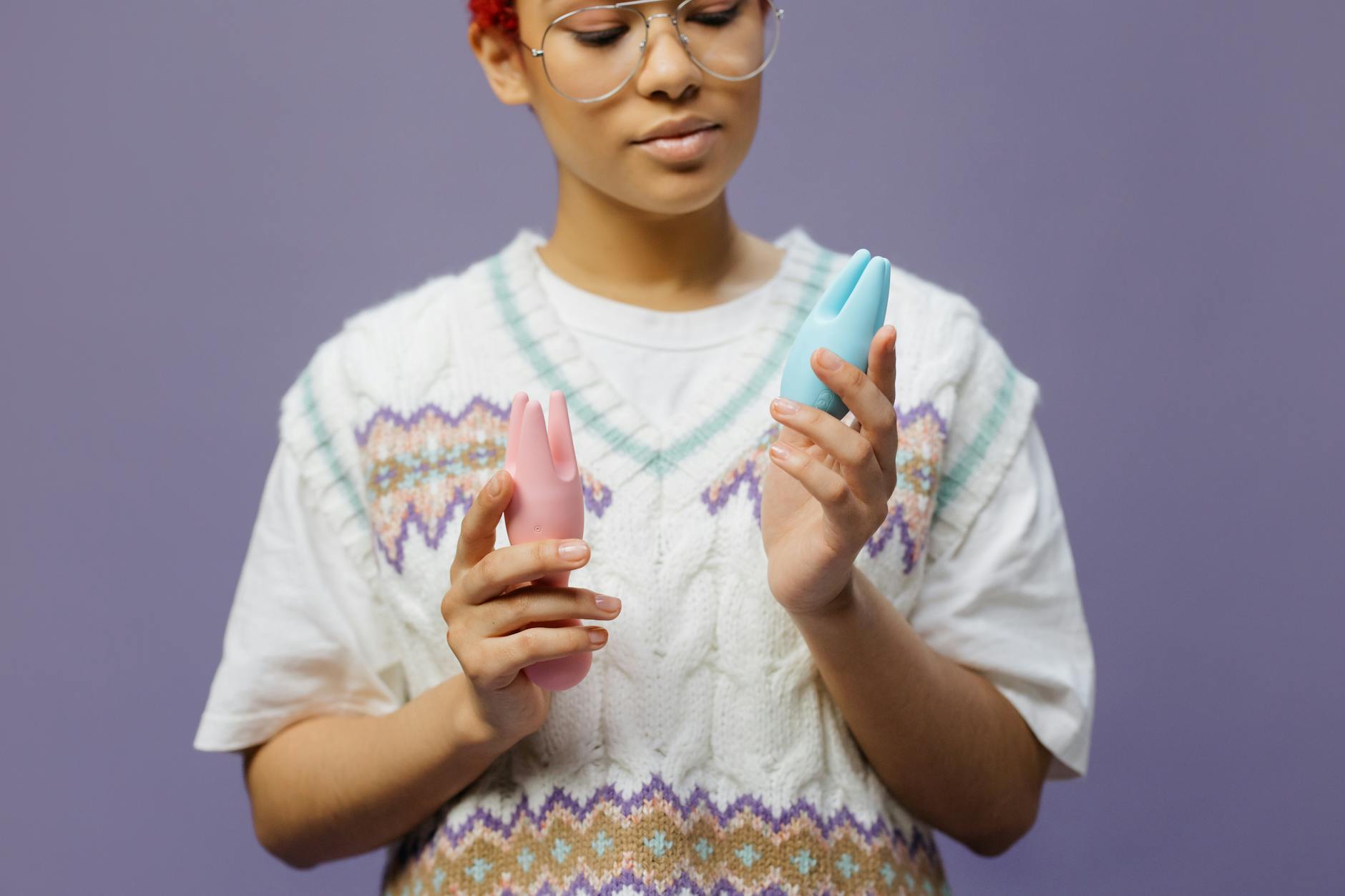
Let's name the thing nobody talks about
You've read about lemon vibrators. You've thought about trying one. And then the anxiety hits. What if it feels weird? What if you can't orgasm with it? What if you're doing it wrong? Your brain goes through twelve different worst-case scenarios before you even open the package.
This isn't about being broken. It's about how your nervous system handles novelty. And there's actually a straightforward way to move through it.
Why anxiety shows up around new toys
When you consider trying a lemon vibrator for the first time, your brain is processing multiple unknowns at once. New sensation. New device. Unfamiliar rhythm. Performance pressure. Maybe comparison to whatever else you've tried. That's a lot of variables, and anxiety loves variables.
Adding a clitoral vibrator to your solo or partnered routine is genuinely different from what your body has experienced before. Suction-based stimulation feels nothing like fingers or tongues. The intensity profile is different. The speed is consistent in a way human touch isn't. Your nervous system notices all of this, and if you're already wired toward caution, it can tip into overwhelm quickly.
Here's the thing though: that caution isn't a flaw. It's information. You're being thoughtful about your pleasure. You just need a framework that respects the caution while still letting you explore.
The anxiety audit: what specifically are you worried about
Not all anxiety is the same. Before you do anything else, get specific about what's actually worrying you.
Are you anxious because you're worried about physical pain or discomfort? That's one conversation. Are you anxious because you feel self-conscious about the whole idea of using a toy? Different conversation. Anxious because you've had bad experiences with toys before? Also different. Anxious because your partner might judge you? Separate issue entirely.
Spend ten minutes writing down what specifically makes you nervous. Not vague dread. Concrete worry: "I'm worried the vibration will feel too intense," or "I'm afraid I won't be able to come and then I'll feel broken," or "I'm embarrassed about the noise." Once you name the actual worry, you can address it directly instead of white-knuckling your way through the experience.
Building a safe-to-fail first experience
The goal of your first time isn't to have the best orgasm of your life. It's to prove to your nervous system that this is low-stakes and survivable. You're gathering data, not passing a test.
Set yourself up to win by removing as many variables as possible. Pick a time when you're not rushed. You're not on a schedule. You're not worried about a partner coming home. You've got a solid hour if you want it, and zero pressure to come. This alone cuts anxiety by about 60 percent.
Start clothed. Not joking. Sit with the device still in its box. Hold it. Look at it. Let your nervous system get used to the idea of it existing in your space. This takes maybe five minutes and feels silly, but it's neurologically useful. You're habituating to the novelty without any performance pressure.
Then take it out of the box. Turn it on at the lowest setting. Just listen to the sound. Feel the vibration against your hand. No genitals involved yet. Let your body learn that this is a real object with a real sensation profile, and it's not going to surprise you later. Five more minutes, maximum.
The gradual exposure that actually works
Once you're comfortable with the device itself, the next phase is slowly introducing it to sensation play without orgasm pressure.
When you're ready to explore with your body, start with the lowest setting. Touch it to your inner thigh first. Not your clitoris. Your thigh. It's got nerve endings. You'll feel the sensation. Your brain will start mapping "lemon vibrator equals this feeling." Let yourself sit with that for a minute.
Move it slowly up the inner thigh toward your vulva. Pause. Let your nervous system catch up. There's no rush. This is exploration, not a race to orgasm. Many people find that once they slow down and actually notice what's happening, the anxiety loses its grip.
When you're ready, move to your labia. Not your clitoris yet. The sides, the outer folds, the areas that are sensitive but feel less intense. Stay here for several minutes. Let yourself enjoy this phase without moving toward climax. This is genuinely pleasurable on its own, and it teaches your body that the device is a tool for sensation, not just a means to an orgasm.
Only when you feel genuinely ready, bring it to your clitoris at the lowest setting. If this still feels too intense, go back to the labia. There's no timeline. You're literally retraining your nervous system to expect novelty without catastrophizing.
What to do when the anxiety spikes mid-way
Okay, you're exploring, and suddenly the thoughts arrive. "This feels weird." "Am I doing this right?" "What if I can't come?" Your nervous system is checking in to make sure you're still safe.
Here's what works: pause, but don't stop entirely. Keep the device on your vulva at the lowest setting. Don't turn it off. Just pause your movement. Breathe. Notice what's actually happening in your body right now, versus what you're worried might happen. Often the sensation is fine. The worry was the problem.
Think of your nervous system as an overprotective friend. It's not trying to ruin things. It's trying to keep you safe. You can acknowledge that and still move forward. "Thanks for checking in. I'm actually okay here. We can keep going."
If the anxiety doesn't settle after a few breaths, turn the device off and take a real break. This isn't failure. This is information. You're learning what your threshold is, and that matters. You can try again tomorrow or next week. There's no deadline.
The partner conversation that changes everything
If you're exploring with a partner, don't skip this step. Half the anxiety about trying a lemon vibrator comes from worrying about what your partner will think.
Before you introduce the device, have an actual conversation. Not in the bedroom. Not in the moment. Sitting on the couch, fully clothed, you say something like: "I want to try exploring with a vibrator. I'm a little nervous about it. Can we talk about what that looks like for you?" Listen to what they say. They might be excited. They might have their own nervousness. They might want to help. You don't know until you ask.
Many partners are relieved to hear this. They're not mind-readers. They don't know if you want them involved or want solo time. They don't know if you want them watching or not watching. Clarity reduces anxiety for both of you. You're collaborating, not surprising each other.
The physiology of pleasure when you're nervous
Here's something useful: your body can't simultaneously be in deep relaxation and deep arousal. But it can be in mild arousal while still being somewhat activated. That's your sweet spot when you're anxious.
Lowering the intensity setting of your lemon vibrator keeps you in that middle zone. You're not overwhelmed. You're not understimulated. You're in the goldilocks zone where your nervous system can learn that this is pleasurable without flipping into fight-or-flight.
Don't push yourself to higher intensities because you think you should. "Should" is anxiety's best friend. Stay at the intensity that feels good, even if it's the lowest setting. Use it for as long as you want. Take breaks whenever you want. Your pleasure is never a performance.
When to know you're ready to go deeper
After a few sessions at low intensity, you'll notice something shifts. The device stops feeling foreign. Your nervous system stops treating it like a threat. You might feel curious about what the next setting feels like, or you might want to use it for longer, or you might want to focus on different areas. That's readiness. That's your body saying, "Okay, I trust this now."
There's no timeline for this. Some people feel ready in two or three sessions. Some take two or three weeks. Both are completely normal. You're not behind. You're not slow. You're being attentive to your own system, and that's the opposite of anxious. That's wise.
The self-compassion piece that makes it stick
Before you explore with any clitoral vibrator, including a lemon vibrator, commit to this: you're going to speak to yourself the way you'd speak to a friend who was nervous about trying something new. Not harsh. Not pushy. Encouraging and patient.
If it feels weird, that's information, not failure. If you don't orgasm, that's not a referendum on your body. If you need to stop, stopping is the right call. Anxiety thrives on self-judgment. It dies in the presence of genuine self-compassion.
Your desire to explore is already a form of courage. The caution you're feeling is your nervous system doing its job. You're not broken for having both. You're just human.
People also ask
Can anxiety actually prevent orgasm with a lemon vibrator?
Yes, absolutely. When your nervous system is in a heightened state, it's harder to reach orgasm because your parasympathetic nervous system (the relaxation system) isn't fully engaged. This is why lowering the stakes and removing pressure matters so much. As you relax, your body's natural capacity for pleasure comes back online. It's not the vibrator that's the problem. It's the activated nervous system. Address the activation, and orgasm usually follows.
How long should I wait between trying my lemon vibrator if I feel anxious the first time?
There's no set rule, but 24 to 48 hours is a good baseline. This gives your nervous system time to process the experience and settle before you try again. You're not waiting because you failed. You're spacing it out so each session feels fresh and low-pressure. If a week feels better, take a week. Your timeline is the right timeline.
Is it normal to feel self-conscious even when I'm alone?
Completely. Self-consciousness isn't always about someone watching you. It can be internalized cultural messaging about what's "normal" or "okay" to want. That takes time to work through. Using a lemon vibrator alone, without judgment, is actually one of the most direct ways to challenge that internalized voice. You're proving to yourself that your pleasure matters, and that's radical.
What if my partner makes me feel more anxious about trying a vibrator?
This is worth taking seriously. A partner's job is to support your exploration, not police it. If they're making you feel ashamed or pressured, that's a relationship dynamic worth examining. Consider starting solo. Build your own relationship with pleasure first. You can always involve a partner later, but your sense of safety with yourself comes first.
Can I use my lemon vibrator if I'm taking anxiety medication?
Yes. Some medications can affect sensation or orgasm capacity, but that's a separate conversation from anxiety about the device itself. If your medication affects sexual response, that's worth discussing with your doctor, but it doesn't make exploring a lemon vibrator wrong. You work with what your body is actually doing, not what you wish it would do.
How do I know if my anxiety about vibrators is normal or if it signals something deeper?
Nervousness about novelty is normal. But if anxiety about sexuality is a pattern that affects other areas of your life, or if you have a history of trauma, that's worth exploring with a therapist. There's no shame in getting support. A good therapist can help you understand what's underneath the anxiety and give you actual tools. This isn't something you have to white-knuckle through alone.
The thing about courage and caution
Using a lemon vibrator when you're anxious about trying new things isn't about conquering the fear. It's about moving forward while the fear is still there. That's what courage actually is. Not fearlessness. Willingness to explore even when you're nervous.
Your anxiety has kept you safe in other contexts. That's its job. But in this moment, you get to decide whether the caution is useful or whether it's getting in the way of something you actually want. If you want to explore, you can. Slowly. Gently. On your own timeline. Your pleasure deserves that kind of care.
If you're ready to start, remember: lowest setting, clothed first, no orgasm agenda, and genuine self-compassion. That combination works. Not because you're special. Because that's how humans actually learn to feel safe with new things. Start there, and the rest will unfold.